The cat (Felis catus)
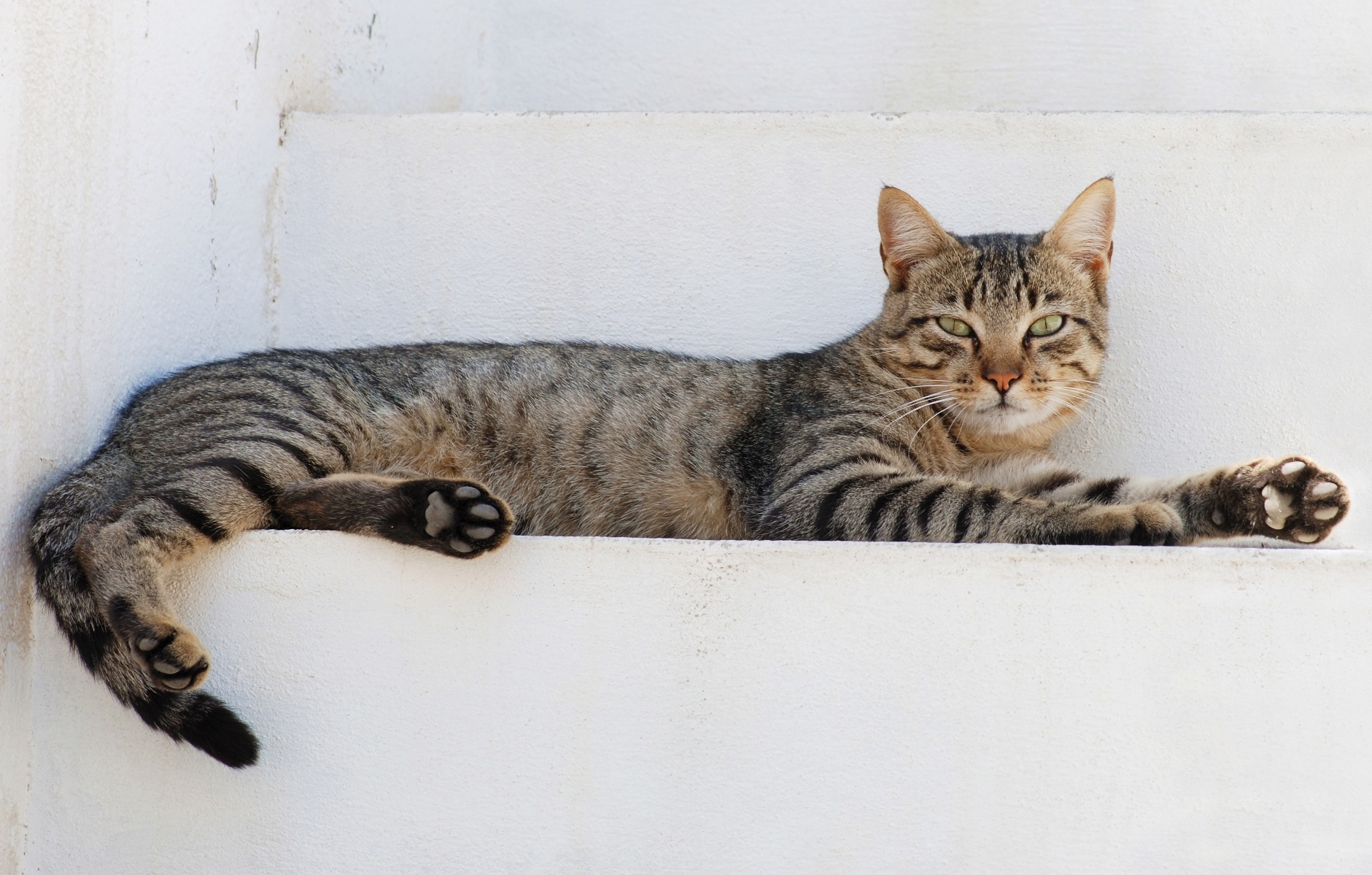
The cat (Felis catus), also called domestic cat and house cat, is a small carnivorous mammal. It is an obligate carnivore, requiring a predominantly meat-based diet. Its retractable claws are adapted to killing small prey species such as mice and rats. It has a strong, flexible body, quick reflexes, and sharp teeth, and its night vision and sense of smell are well developed. It is a social species, but a solitary hunter and a crepuscular predator. Cat communication includes meowing, purring, trilling, hissing, growling, grunting, and body language. It can hear sounds too faint or too high in frequency for human ears, such as those made by small mammals. It secretes and perceives pheromones. Cat intelligence is evident in its ability to adapt, learn through observation, and solve problems. Female domestic cats can have kittens from spring to late autumn in temperate zones and throughout the year in equatorial regions, with litter sizes often ranging from two to five kittens.
The domestic cat is the only domesticated species of the family Felidae. Advances in archaeology and genetics have shown that the domestication of the cat started in the Near East around 7500 BCE. Today, the domestic cat occurs across the globe and is valued by humans for companionship and its ability to kill vermin. It is commonly kept as a pet, working cat, and pedigreed cat shown at cat fancy events. Out of the estimated 600 million domestic cats worldwide, 400 million reside in Asia, including 58 million in China. About 73.8 million cats are estimated to live in the United States, and about 10.9 million cats the United Kingdom. It also ranges freely as a feral cat, avoiding human contact. Pet abandonment contributes to increasing of the global feral cat population, which has driven the decline of bird, mammal, and reptile species. Population control includes spaying and neutering.
Etymology and naming
The origin of the English word cat, Old English catt, is thought to be the Late Latin word cattus, which was first used at the beginning of the 6th century.[4] The Late Latin word may be derived from an unidentified African language.[5] The Nubian word kaddîska 'wildcat' and Nobiin kadīs are possible sources or cognates.[6]
The forms might also have derived from an ancient Germanic word that was absorbed into Latin and then into Greek, Syriac, and Arabic.[7] The word may be derived from Germanic and Northern European languages, and ultimately be borrowed from Uralic, cf. Northern Sámi gáđfi 'female stoat', and Hungarian hölgy 'lady, female stoat'; from Proto-Uralic *käďwä 'female (of a furred animal)'.[8]
The English puss, extended as pussy and pussycat, is attested from the 16th century and may have been introduced from Dutch poes or from Low German puuskatte, related to Swedish kattepus, or Norwegian pus, pusekatt. Similar forms exist in Lithuanian puižė and Irish puisín or puiscín. The etymology is unknown, but it may be an onomatopoeia from using a sound to attract a cat.[9][10]
A male cat is called a tom, tommy or tomcat[11] (or a gib,[12] if neutered). A female is called a queen (or sometimes a molly,[13] if spayed).[14] Some sources write that queen refers solely to unspayed cats that are in an estrous cycle.[15] A juvenile cat is referred to as a kitten (shortened to kitty in British English[16]), a term interchangeable with the now-obsolete word catling in Early Modern English.[17] A group of cats can be referred to as a clowder, a glaring,[18] or a colony.[19]
Taxonomy
The scientific name Felis catus was proposed by Carl Linnaeus in 1758 for a domestic cat.[1][2] Felis catus domesticus was proposed by Johann Christian Polycarp Erxleben in 1777.[3] Felis daemon proposed by Konstantin Satunin in 1904 was a black cat from the Transcaucasus, later identified as a domestic cat.[20][21]
In 2003, the International Commission on Zoological Nomenclature conserved the name silvestris Erxleben 1777 for the wildcat, but did not suppress catus Linnaeus 1758.[22][23] In 2007, the modern domesticated subspecies F. silvestris catus was sampled worldwide and considered to have probably descended from the African wildcat (F. lybica), following results of phylogenetic research.[24][25][a] In 2017, the IUCN Cat Classification Taskforce, following the recommendation of Gentry et al. (2004)[23] that names based on domestic forms be used for domestic derivatives of wild species, regarded the domestic cat as a distinct species, Felis catus.[26]